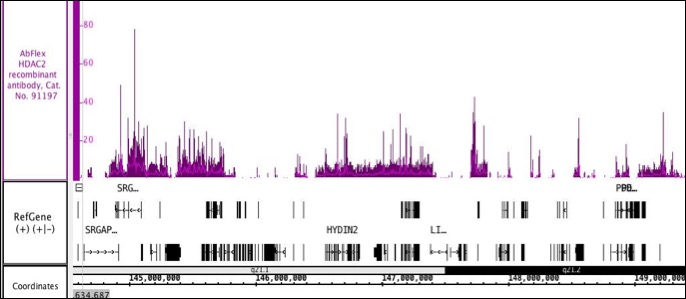
AbFlex® HDAC2 antibody (rAb), sample
AbFlex antibodies are recombinant antibodies (rAbs) that have been generated using defined DNA sequences to produce highly specific, reproducible antibodies. Each AbFlex antibody contains a 6xHis Tag, a Biotinylation Tag for enzymatic biotin conjugation using the biotin ligase, BirA, and a sortase recognition motif (LPXTG) to attach a variety of labels directly to the antibody including fluorophores, enzymatic substrates (HRP, AP), peptides, drugs as well as solid supports. HDAC2 (Histone Deacetylase 2, also designated mammalian RPD3) is a member of the class I mammalian histone deacetylases (HDACs) involved in regulating chromatin structure during transcription. These enzymes catalyze the removal of acetyl groups from lysine residues of histones and other cellular proteins. Lysine N-e-acetylation is a dynamic, reversible and tightly regulated protein and histone modification that plays a major role in regulation of gene expression in various cellular functions. It consists of the transfer of an acetyl moiety from an acetyl coenzyme A to the e-amino group of a lysine residue. In vivo, acetylation is controlled by the antagonistic activities of histone acetyltransferases (HATs) and histone deacetylases (HDACs). The HDACs are grouped into four classes, on the basis of similarity to yeast counterparts: HDAC class I (HDAC1, HDAC2, HDAC3 and HDAC8), class II (HDAC4, HDAC5, HDAC6, HDAC7, HDAC9 and HDAC10), class III (SIRT1, SIRT2, SIRT3, SIRT4, SIRT5, SIRT6 and SIRT-7) and class IV (HDAC11). HDAC2 is associated with many different proteins as YY1 (a mammalian zinc-finger transcription factor). HDAC2 also forms transcriptional repressor complexes containing, among others, HDAC1 or RBBP4. HDAC1, HDAC2 and HDAC3 are also ubiquitously expressed and can deacetylate both Histone H3 and Histone H4 in free histones or nucleosome substrate.